
Free Tools Offered by Spare8: Plan Your SIP, FD, RD, SWP and Lumpsum (2026 Guide)
By Spare8 · Updated 18 October 2026 · 16 min read
Spare8 offers a set of free tools that help you plan your money before you invest. Enter an amount, a time and a rate, and see what you could end up with. You also see what waiting, or picking the wrong tool, could cost.
This guide walks through every free tool: SIP, lumpsum, FD, RD, SWP, gold rates and price alerts. It works as a financial calculator guide for India. A SIP, or systematic investment plan, simply means investing a fixed amount at regular gaps. Each section gives the formula, a worked example in ₹ and a few tips.
Which financial calculator do I need?
All the free tools below are open to everyone. The right financial calculator in India depends on what you are trying to do, so find your situation in the table, then jump to that tool.
| Your situation | Start with | Why |
|---|---|---|
| I can save a fixed amount every month | Gold SIP, RD or SIP calculator | All three build a monthly habit. RD pays a fixed rate. A Gold SIP buys gold. The SIP calculator uses a return you choose. |
| I have a lump sum, such as a bonus or a matured FD | Lumpsum or FD | Lumpsum shows growth at a return you pick. FD shows a fixed return and the tax on it. |
| I need a monthly income from my savings | SWP | It shows how long your money lasts at the withdrawal you choose. |
| I want to buy gold at a price I am happy with | Gold Rate Today and Price Alerts | See the live rate, then get told when it reaches your target. |
Not sure? Run two calculators on the same money. Seeing the numbers side by side usually makes the choice clearer.
Gold rate today and price alerts: buy at a price you chose
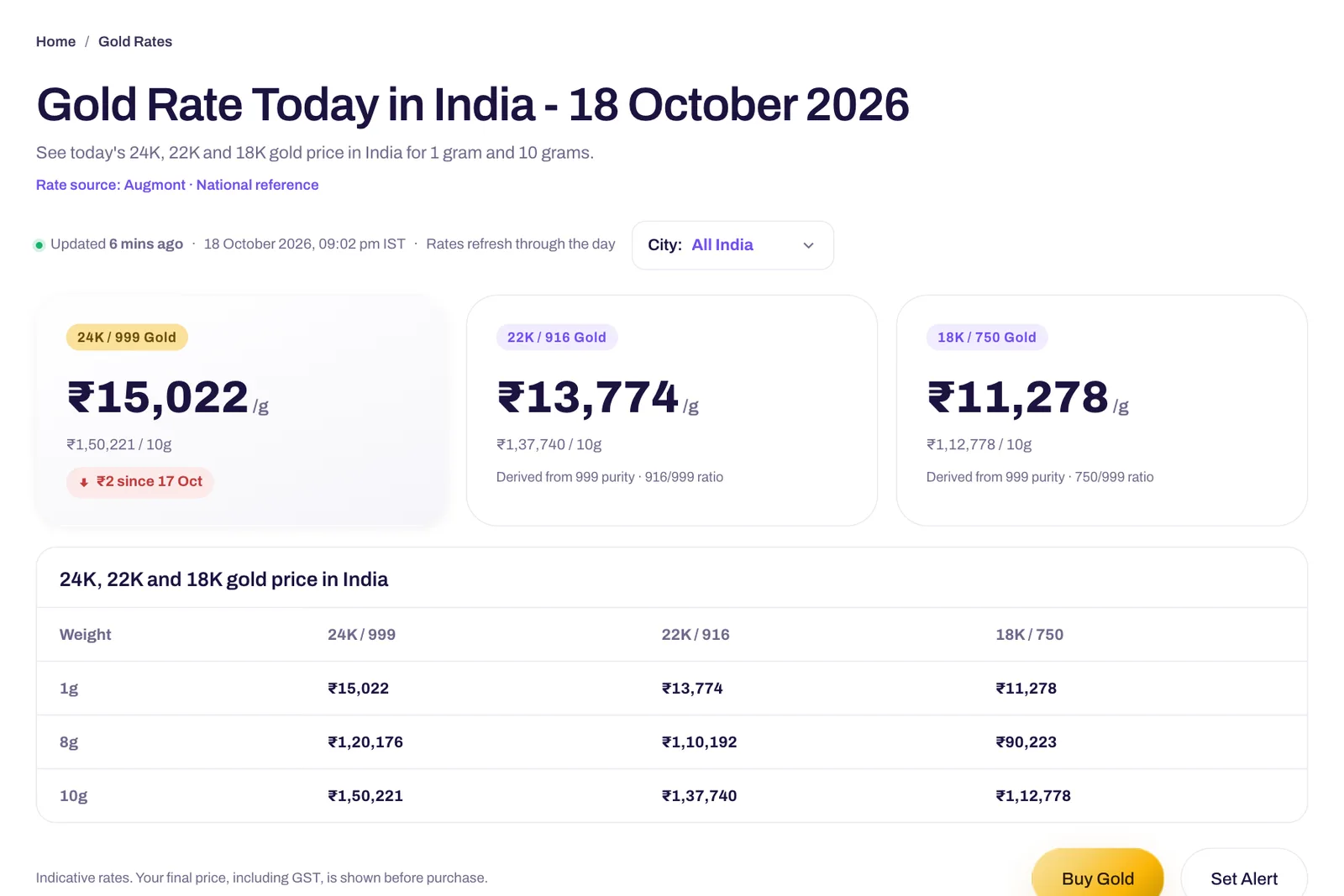
The gold rate today page shows the 24K price per gram, with 22K and 18K estimates, city rates and a price trend. Rates are indicative and refresh through the day. The final price you pay is confirmed in the Spare8 app when you place an order.
Who it’s for: anyone who wants to check the price before buying, or wants to stop checking it every day.
The formula
- 999
- Purity of 24K gold, which is 99.9% pure
- 916
- Purity of 22K gold
- 750
- Purity of 18K gold
Worked example
Say 24K gold is ₹15,000 a gram. This is a round-number illustration, not today’s rate. Then 10 g of 24K is worth ₹1,50,000. The 22K rate works out to about ₹13,754 a gram, and 18K to about ₹11,261.
How to check today’s rate
- Open the gold rates page.
- Pick your city, or stay on the India rate.
- Read the 24K rate and the time it was last checked.
- Look at the trend chart to see whether today’s price is high or low for the past few months.
How to set a one-time alert
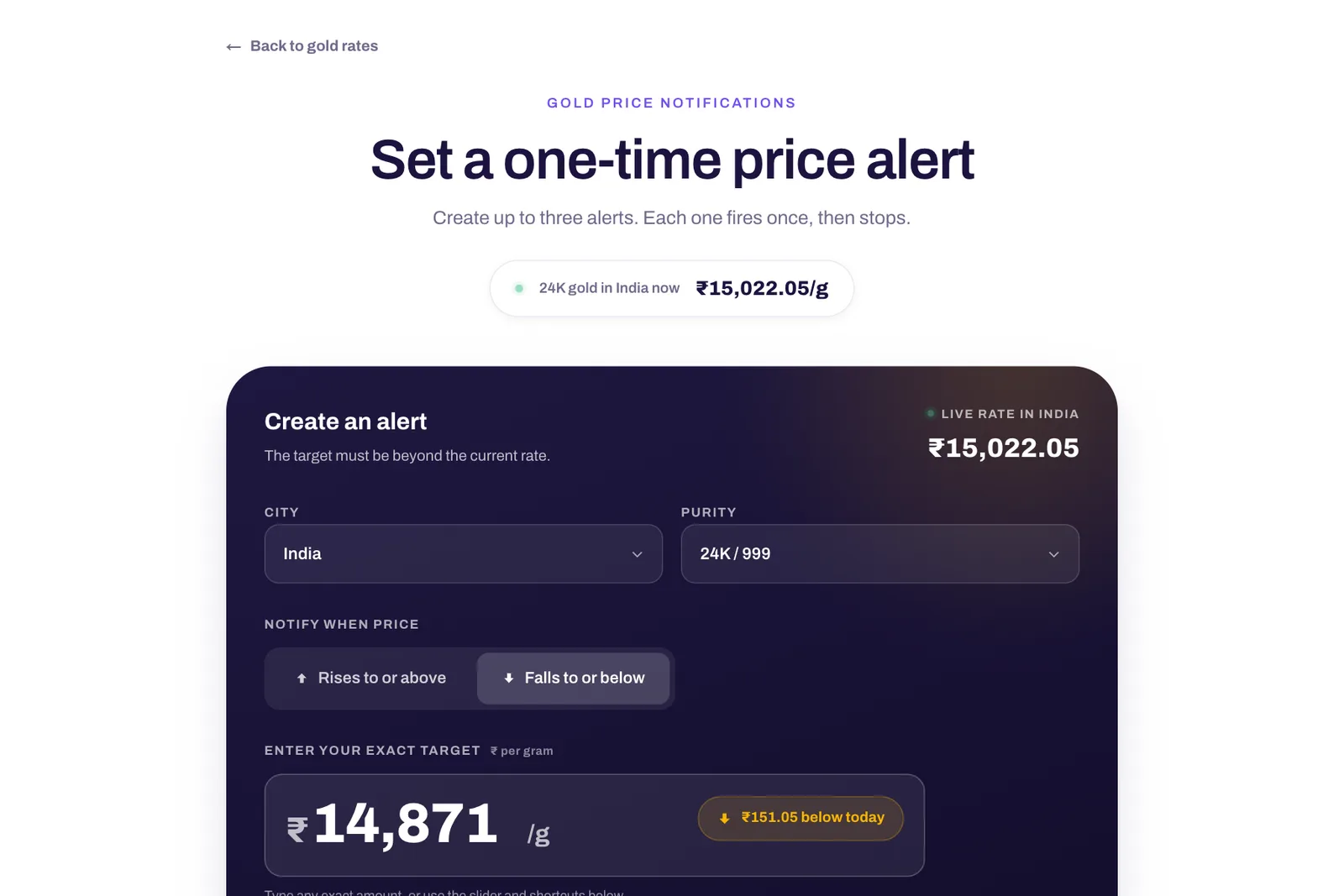
Open gold price alerts, choose 24K, 22K or 18K, pick your city and enter a target rate, above or below the current price. You are notified when gold reaches it. Each alert fires once and then stops. You can keep up to three at a time, and they are tied to your browser, not an account.
Tips
- Do not try to catch the exact bottom. Pick a price you would be happy with, set the alert and carry on.
- Set one alert for a dip and one for a rise, so you hear about both.
- If you invest through a Gold SIP, you do not need to time the price. Alerts are for extra, one-time buys.
Gold SIP calculator: plan monthly saving in 24K gold
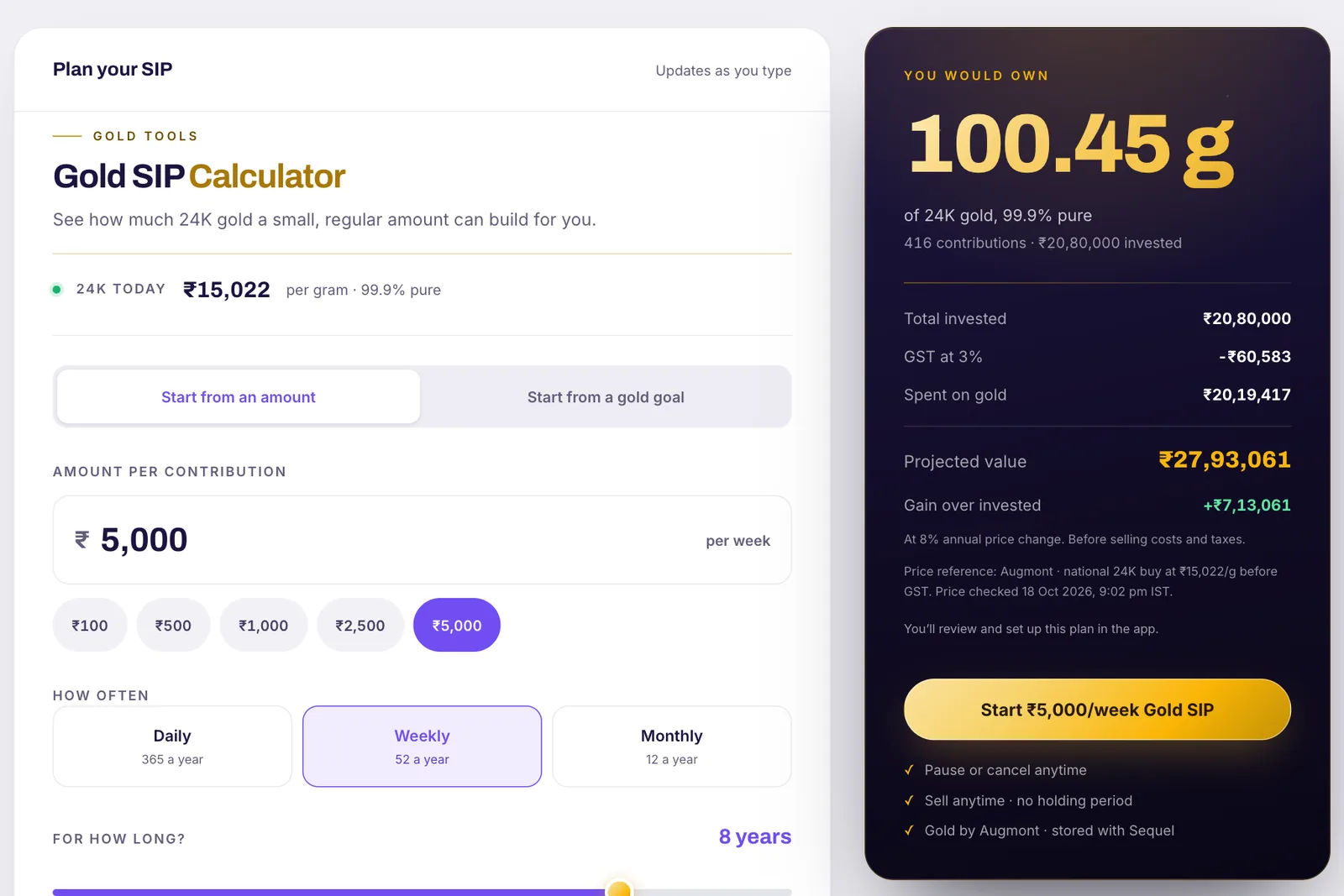
A Gold SIP buys 24K digital gold for you daily, weekly or monthly. The Gold SIP calculator shows how much gold a budget buys at today’s live price. It can also work backwards from a goal to the instalment you need.
Who it’s for: first-time investors, salaried people and anyone who prefers small, regular steps. You can start from ₹10, and you can pause anytime with no penalty.
The formula
- M
- Value at the end
- P
- Amount you invest each time
- i
- Growth rate for one period. An 11% yearly rate becomes about 0.87% a month.
- n
- Number of instalments. Monthly for 10 years is 120.
This is compounding: your earlier gains start earning too. The final × (1 + i) assumes each instalment goes in at the start of its period.
Worked example
₹5,000 a month for 10 years at about 11% a year grows to ₹10,62,149. You paid in ₹6,00,000, so the estimated gain is ₹4,62,149.
The 11% is a long-term historical average for gold. It is not guaranteed, and gold prices can fall. In a weak decade you could end up with less than you put in. The calculator also takes 3% GST off each instalment before buying, so your real grams will be a little lower than this simple maths shows.
Tips
- Pick an amount you will not miss. Staying regular matters more than starting big.
- Use the goal mode to work backwards. Enter the amount you want and see the instalment it needs.
- Try daily, weekly and monthly. The total is similar, but a smaller daily amount can feel easier.
- Run it again each year. Raise the instalment when your income rises.
If your SIP is in a mutual fund rather than gold, use the SIP calculator. It lets you enter your own expected return and compares it with a Gold SIP.
Lumpsum calculator: what a one-time investment can grow to
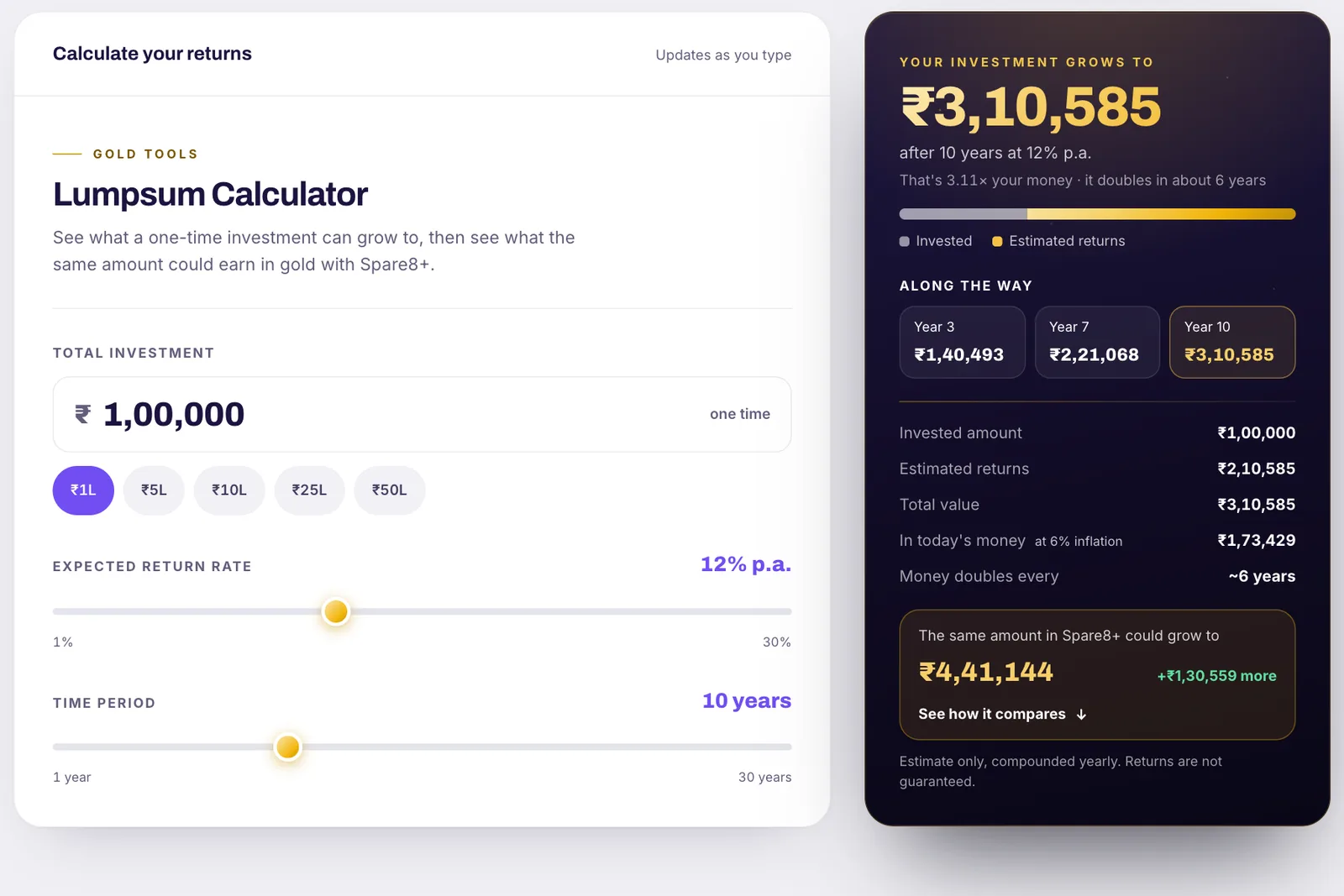
A lumpsum is one single amount that you invest in one go, instead of in monthly instalments. The lumpsum calculator shows what that amount could be worth after a number of years at a return you choose.
Who it’s for: anyone who has received a bonus, an inheritance, money from a property sale or a matured FD, and wants to see their options.
The formula
- A
- Total value at the end
- P
- The amount you invest
- r
- Expected yearly return, as a decimal. 10% is 0.10.
- t
- Number of years you stay invested
Worked example
₹10,00,000 at 10% a year for 5 years becomes ₹16,10,510, a gain of ₹6,10,510.
CAGR stands for compound annual growth rate. It is the single steady yearly rate that takes you from the start value to the end value: (End ÷ Start)1 ÷ years − 1. Here, (16,10,510 ÷ 10,00,000)1 ÷ 5 − 1 = 10%. Use CAGR to compare two investments that ran for different lengths of time.
Tips
- Keep your emergency fund out of it. Many people hold about six months of expenses in cash first.
- Try three returns, say 8%, 10% and 12%. A range is more honest than one number.
- Look at the effect of inflation, the yearly rise in prices. At 6% inflation, ₹16,10,510 in 5 years buys what about ₹12,03,467 buys today.
- If timing worries you, split the amount into a few parts and invest them over several months.
FD calculator: know your maturity amount and what tax leaves
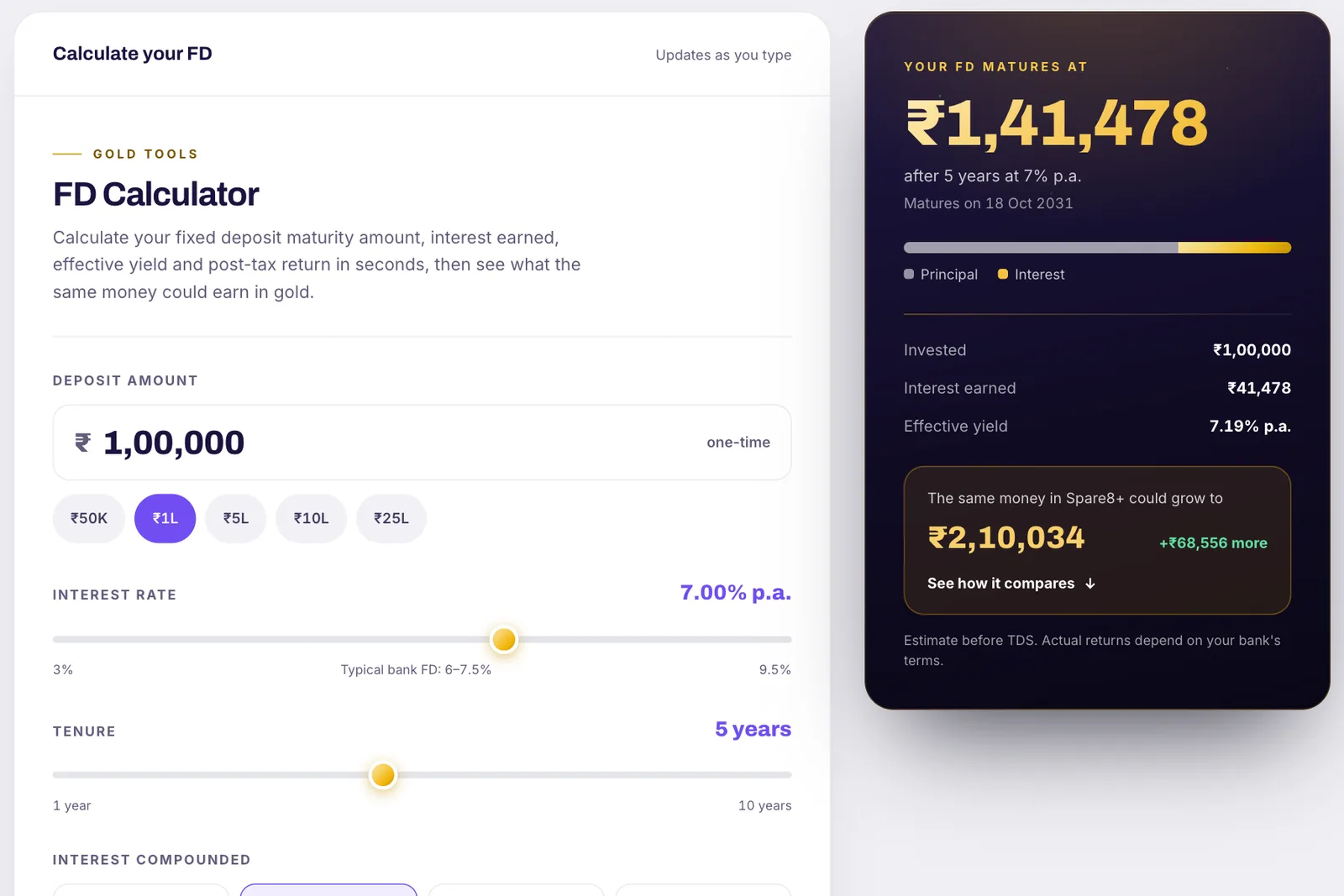
A fixed deposit (FD) is a deposit with a bank for a fixed time at a fixed interest rate. In a cumulative FD, the interest is added back and paid with your money at maturity. The FD calculator shows that final amount and the interest you keep after tax.
Who it’s for: savers who put safety first, retirees, and anyone saving for a goal a few years away.
The formula
- A
- Maturity amount
- P
- Amount you deposit
- r
- Yearly interest rate, as a decimal
- n
- Times interest is added each year. Most banks use 4, which is quarterly.
- t
- Tenure in years
Worked example
₹5,00,000 at 7% for 5 years, compounded quarterly matures at ₹7,07,389. The interest is ₹2,07,389.
FD interest is added to your income and taxed at your slab rate. The slab is the tax rate for your income band. At the 30% slab, the tax on this interest is about ₹62,217, so you keep ₹1,45,172 and your money ends at ₹6,45,172. That is a real return of about 5.2% a year, not 7%.
Banks may also deduct TDS, which means tax deducted at source. It is paid to the government in advance on your behalf once your yearly interest crosses a limit. It is not an extra tax. You adjust it when you file your return.
Tips
- Compare the after-tax return, not the headline rate. Pick your slab in the calculator.
- Check the penalty for breaking an FD early before you book it.
- Senior citizens often get a higher rate. Enter the rate your bank actually offers for your tenure.
- Compare banks side by side. Try the SBI and HDFC Bank FD calculators, or see FD and RD rates compared.
RD calculator: turn small monthly deposits into a fixed amount
A recurring deposit (RD) lets you deposit a fixed amount every month, with a bank or the Post Office, for a set time at a fixed rate. You do not need a lump sum. The RD calculator shows your maturity amount, the interest earned and the tax effect.
Who it’s for: first-time savers and anyone who wants a predictable result from a regular monthly habit.
The formula
Each monthly instalment compounds quarterly for the months it stays deposited. Work out one instalment, then add them all up.
- A
- Maturity value of one instalment
- P
- Your monthly instalment
- r
- Yearly interest rate, as a decimal
- n
- Compounding periods a year. Use 4 for quarterly.
- t
- Years that instalment stays deposited
The first instalment stays for the full term, so it earns the most. The last one stays for a single month.
Worked example
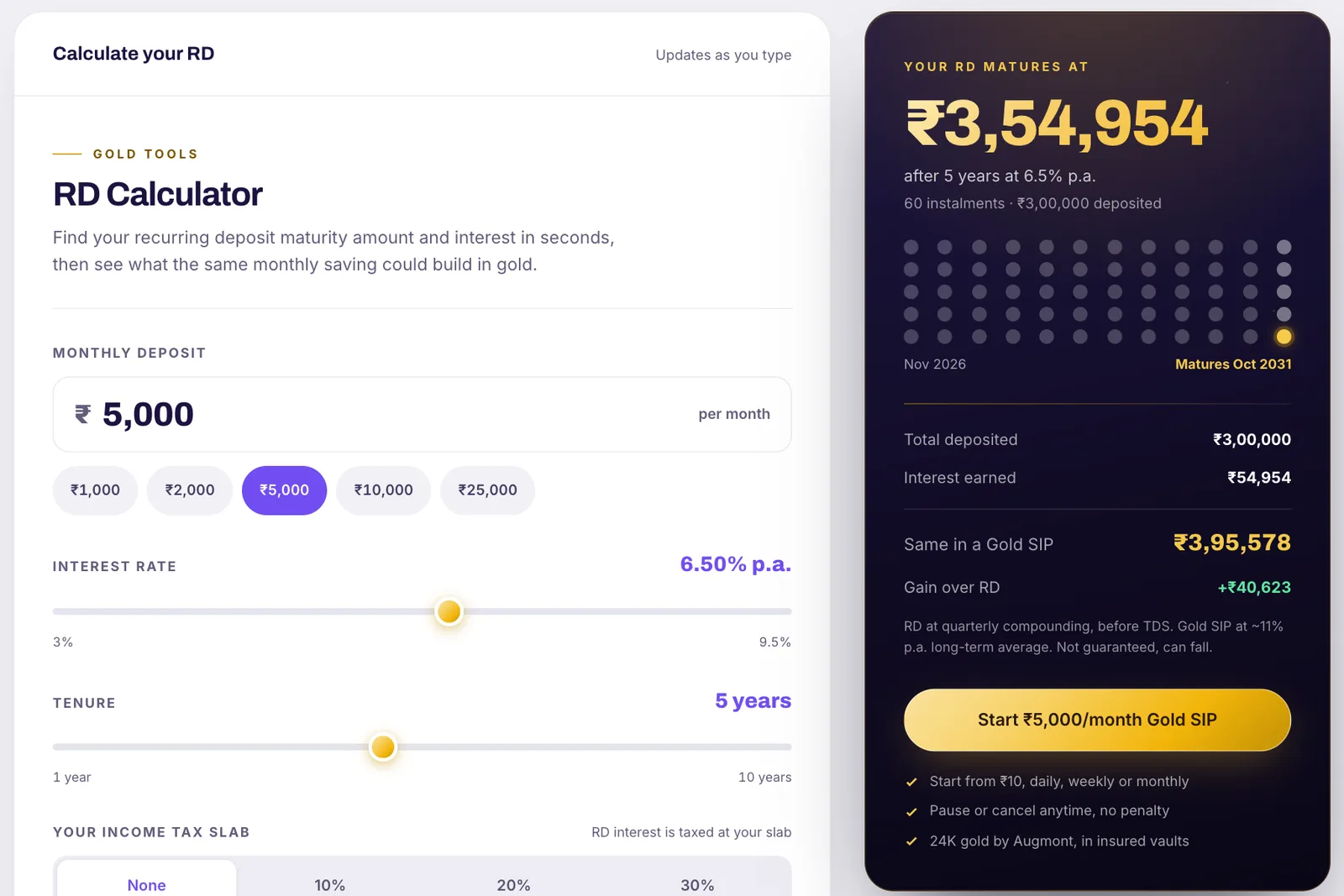
₹5,000 a month for 5 years at 6.5% matures at ₹3,54,954. You deposited ₹3,00,000, so the interest is ₹54,954.
RD interest is also taxed at your slab, and banks may deduct TDS once it crosses the yearly limit.
Tips
- Set the instalment to debit on salary day. Banks usually charge a fee for each missed instalment.
- Match the tenure to the goal. Most bank RDs run from 6 months to 10 years, and Post Office RDs run for 5 years.
- Check the penalty for closing early. It is usually a lower rate on the amount paid in.
- Compare banks, for example the SBI RD calculator and the Post Office RD calculator.
SWP calculator: plan a monthly income from your savings
A systematic withdrawal plan (SWP) takes a fixed amount out of a mutual fund every month. The rest stays invested and keeps growing. The SWP calculator shows your final balance and how long your money lasts. Your total invested amount is called the corpus.
Who it’s for: retirees, people on a career break, parents paying school fees, and anyone who wants a regular payout from savings.
The formula
The calculator works month by month. It takes out your withdrawal first, then adds one month of growth on what is left.
- W
- Your monthly withdrawal
- i
- Monthly return, which is the yearly return divided by 12
The key rule: your withdrawals stay sustainable if your yearly withdrawal is below your fund’s yearly return. The break-even withdrawal is W = P × i ÷ (1 + i), where P is the corpus. At that level the balance stays where it started.
Worked example
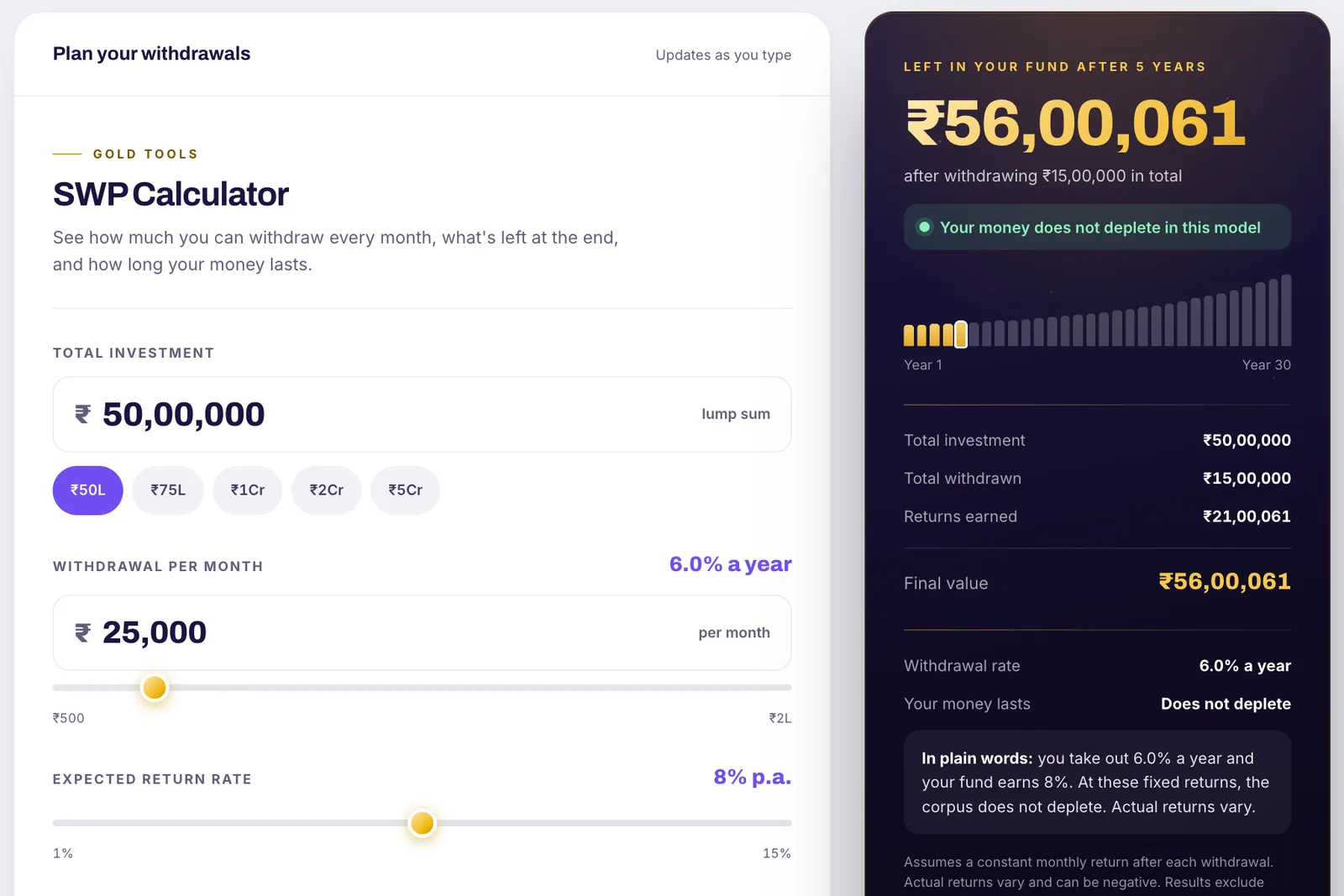
₹50,00,000 corpus, ₹25,000 a month, fund return 8%. You withdraw ₹3,00,000 a year, which is 6% of the corpus. That is below 8%, so after 5 years the balance is about ₹56,00,061, even after taking out ₹15,00,000.
Now raise the withdrawal to ₹50,000 a month. That is 12% a year, above the 8% return. The balance falls to about ₹37,50,893 after 5 years and runs out in roughly 13 years and 8 months. The break-even withdrawal here is ₹33,113 a month.
Real funds do not return a steady 8%. SWP returns are not guaranteed, and a bad early year can shorten how long the money lasts.
Tips
- Start with a withdrawal comfortably below the return you expect. No withdrawal rate is guaranteed safe.
- Keep about a year of expenses in a bank account. You will not have to sell units after a market fall.
- Review once a year. After a poor year, consider trimming the withdrawal.
- Each withdrawal is a redemption of units, and the gain part is taxed based on the fund type and how long you held it.
SIP vs lumpsum, FD vs gold, RD vs Gold SIP
These choices come up again and again. None of them has one right answer. The tables show how each pair differs, so you can match each to a job.
SIP vs lumpsum
| SIP | Lumpsum | |
|---|---|---|
| How you invest | A fixed amount at regular gaps | One amount, all at once |
| Money needed upfront | Only the first instalment | The full amount |
| Timing risk | Spread across many dates | All on one date |
| Best for | Investing from monthly income | A bonus, sale or matured FD |
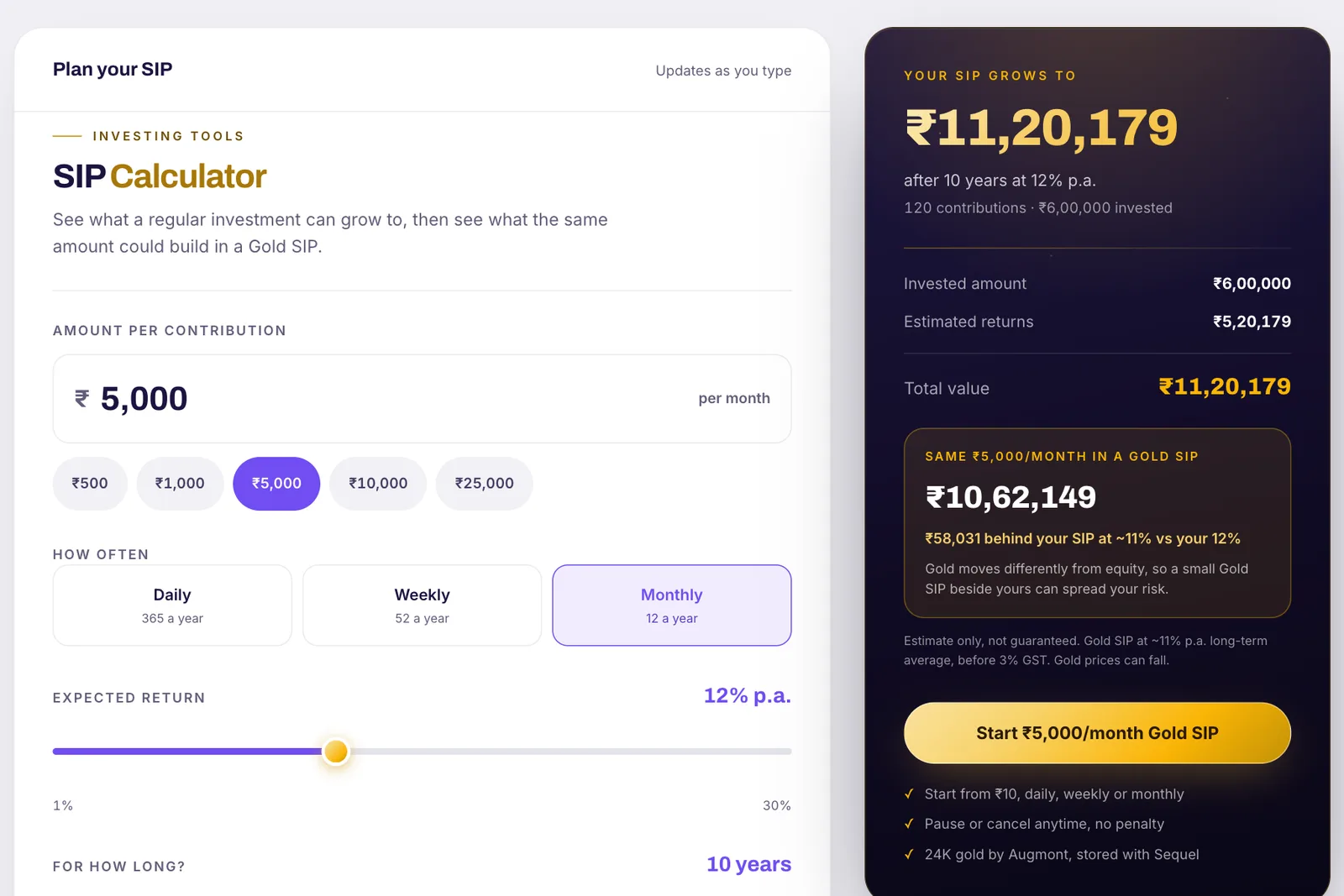
A quick example at 12% a year. ₹5,000 a month for 10 years becomes ₹11,20,179 on ₹6,00,000 paid in. Investing that same ₹6,00,000 on day one becomes ₹18,63,509. The lumpsum looks bigger only because all the money started working on day one. Most people do not have ₹6,00,000 on day one, and that is exactly what a SIP is for. Try your own numbers in the SIP calculator and the lumpsum calculator.
FD vs gold
| FD | Gold | |
|---|---|---|
| Return | Fixed when you book it | Not fixed. The long-term historical average is about 11% a year, and it is not guaranteed. |
| Risk | Low | Prices can rise or fall |
| Tax on gains | Interest taxed at your slab | Has its own rules. Check the current ones. |
| Breaking early | Usually a penalty | No lock-in on Spare8 gold |
| Best for | Fixed, near-term goals | A long-term slice that moves differently from your other savings |
You do not have to choose. Take ₹5,00,000 for 5 years. All in an FD at 7% it becomes ₹7,07,389. Now put ₹4,00,000 in the FD and add ₹1,00,000 of new money in gold. If gold repeats its ~11% average, the total is ₹7,34,417. If gold instead falls 20%, the total is ₹6,45,911. Your FD still did its job, and the dip was limited to the slice. Use new savings for the gold slice. Do not break an FD early to buy it.
RD vs Gold SIP
| RD | Gold SIP | |
|---|---|---|
| Smallest amount | Usually ₹100 to ₹500 a month | ₹10 |
| Return | Fixed by the bank | Not guaranteed. Moves with the gold price. |
| Stopping early | Usually a penalty | Pause anytime, no penalty |
| Missed payment | Usually a fee | No gold is bought that day |
Example: ₹5,000 a month for 5 years. The RD at 6.5% gives ₹3,54,954, and that figure is what the bank promises. A Gold SIP at the ~11% historical average gives ₹3,95,578, but only if gold grows at that pace. It may not. Many people keep the RD and run a small Gold SIP beside it. See the RD calculator and the Gold SIP calculator.
Where gold fits in your plan
The calculators above show one idea again and again: keep the plan you have and add a slice of gold. Gold moves differently from most other savings, so a small slice can spread your risk. The slice should come from new savings, not from an FD you would have to break. You can use a 10% slice as a starting example, but only you can decide the size.
A Gold SIP, as your monthly slice
With a Gold SIP, you buy 24K gold daily, weekly or monthly from ₹10 and pause anytime with no penalty. Your gold is held 1:1 as 24K, 99.9% pure gold in insured Augmont vaults. The long-term average of about 11% a year is only history. It is not guaranteed, and gold prices can fall.
Spare8+ for gold you already hold
Spare8+ lets you lease your gold to bank-verified jewellers. You earn a fixed 5% a year as a reward, credited daily in gold grams. There is no lock-in. Leasing starts from 0.5 grams and needs KYC.
One thing to understand clearly: the reward rate is fixed, but its rupee value moves with the gold price. Ten grams earns about 0.5 g a year. What that is worth in rupees depends on the gold price on the day.
If you use an SWP
Spare8+ pays its income from the reward, so the gold slice itself is not sold. Here is an example. Say you have ₹50,00,000 and need ₹25,000 a month. Keep ₹40,00,000 in your SWP and put ₹10,00,000 in gold with Spare8+. The 5% reward on ₹10,00,000 is about ₹50,000 of gold a year, or roughly ₹4,167 a month at a steady gold price. Your SWP then needs to pay ₹20,833 a month. That is 6.25% of ₹40,00,000 a year.
This only works when that withdrawal is below what your fund earns. If your fund returns 8%, 6.25% is sustainable in the model. If it returns less than 6.25%, the gold reward will not rescue the plan.
Frequently asked questions
Which is the best financial calculator in India?
There is no single best one. The best calculator is the one that matches your situation. Use a SIP calculator for monthly investing, a lumpsum calculator for one-time money, an FD calculator or RD calculator for bank deposits, and an SWP calculator for monthly income.
Are online financial calculators accurate?
The maths is accurate. The result is only as good as the return you enter, and returns on market-linked investments are not guaranteed. Calculators usually leave out fees, taxes and inflation, so treat the answer as an estimate.
Is SIP or lumpsum better?
Neither is always better. A lumpsum gives all your money more time to grow if you already have it. A SIP suits people investing from monthly income, and it spreads your buying over many dates.
Is FD interest taxable?
Yes. FD interest is added to your income and taxed at your slab rate. Banks may also deduct TDS once your interest crosses a yearly limit. Pick your slab in the FD calculator to see the interest you keep.
How is RD interest calculated?
Most banks and the Post Office compound RD interest quarterly. Each monthly instalment is compounded for the months it stays deposited, and the results are added together to give the maturity value.
How long will my SWP money last?
It depends on your withdrawal, your corpus and your fund’s return. If your yearly withdrawal is below the fund’s yearly return, the money can last in the model. Above it, the corpus shrinks. Real returns vary, so nothing is guaranteed.
Is a Gold SIP better than an RD or FD?
They do different jobs. An RD or FD gives a fixed return. Gold has grown faster over the long run, but it is not guaranteed and can fall. Many people keep their RD or FD and add a small Gold SIP beside it.
What return should I enter in a SIP calculator?
Use a conservative number and try a few. Run 8%, 10% and 12% and look at the range. For gold, the long-term historical average is about 11% a year, which is not guaranteed.
How do I check today’s gold rate and set an alert?
Open the gold rates page to see the 24K, 22K and 18K rates by city. To get notified at a target price, create a free one-time alert on the price alerts page.
What is Spare8+ and is the reward guaranteed?
Spare8+ lets you lease your 24K digital gold to bank-verified jewellers and earn a fixed 5% a year as a reward, credited daily in gold grams, with no lock-in. The rate is fixed, but the rupee value of the reward moves with the gold price, and gold prices can fall.
Plan first. Then add a little gold.
Run the numbers on your own plan with the free calculators. Then start a Gold SIP from ₹10 on UPI autopay. Pause anytime, with no penalty.
This guide is for general education and is not financial, tax or legal advice. Examples use the amounts, rates and years shown, with simple compounding, and exclude fees, taxes and inflation unless stated. The ~11% a year figure for gold is a long-term historical average for illustration only. It is not guaranteed, and gold prices can fall. FD and RD rates, TDS limits and tax rules change, so check the current ones with your bank or a qualified adviser. The Spare8+ reward is a fixed percentage paid in gold grams, and the rupee value of those grams moves with the gold price. Digital gold is held 1:1 with Augmont. Consult a professional before deciding.